

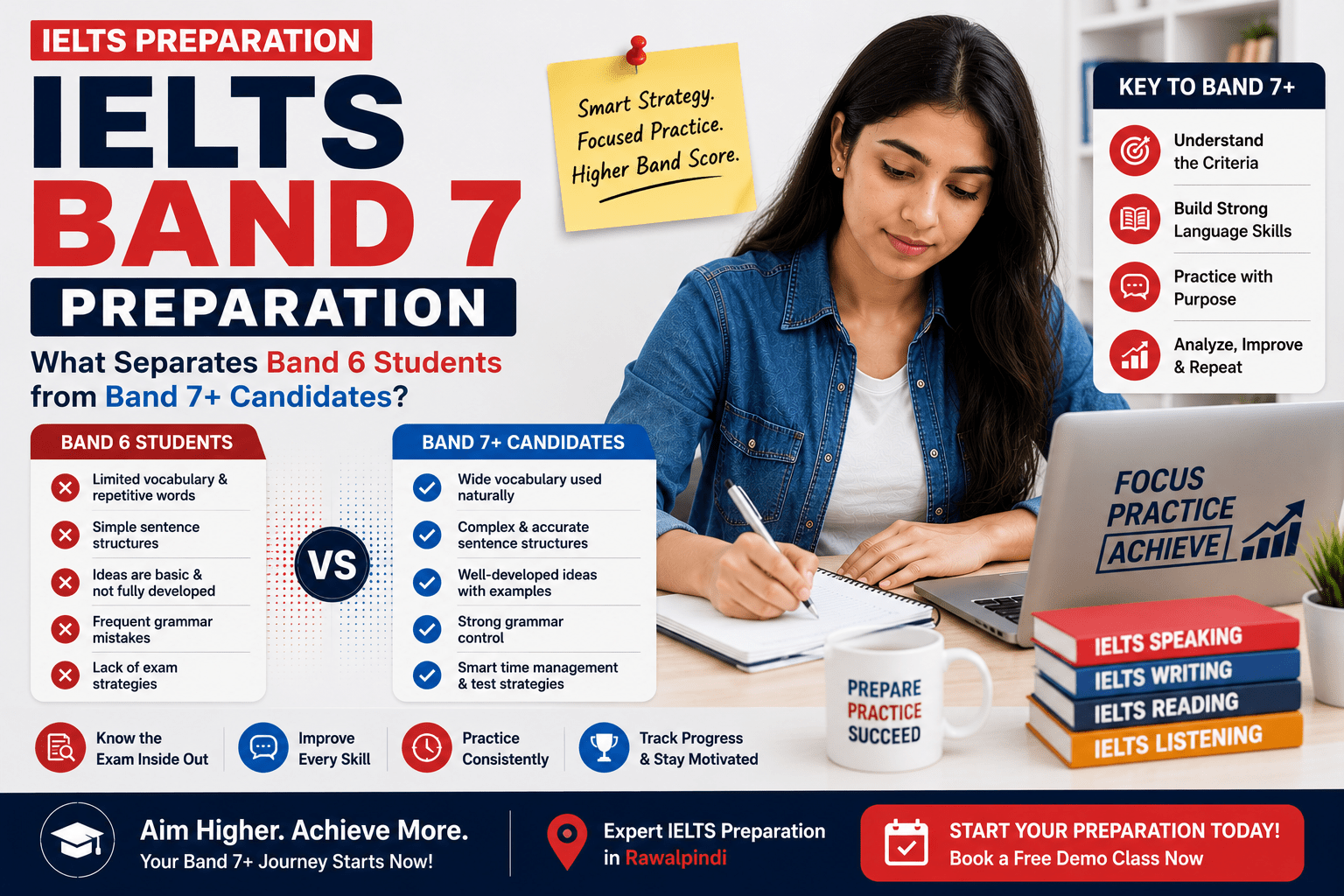
Moving from IELTS Band 6 to Band 7 can feel surprisingly difficult. A student may understand English well, communicate comfortably, and complete plenty of practice tests but still repeatedly receive scores around 6 or 6.5.
The reason is simple: reaching Band 7 is not just about doing more IELTS practice. You need to identify the specific weaknesses keeping individual skills below your target and improve them systematically.
For students searching for IELTS preparation in Rawalpindi, understanding what separates an average response from a stronger one can make preparation much more focused. This guide explores the habits, skills, and common mistakes that often matter when working toward IELTS Band 7 or higher.
First, Stop Thinking of IELTS as One Score
One of the first mistakes candidates make is focusing only on the overall band.
Your IELTS result includes individual scores for:
- Listening
- Reading
- Writing
- Speaking
You might have strong Listening and Reading performance while Writing repeatedly holds your overall result back.
Another student may write effectively but struggle with Speaking fluency.
Therefore, asking:
“How do I get Band 7?”
is less useful than asking:
“Which skill is preventing me from reaching Band 7?”
Once you identify that weakness, your preparation becomes much more targeted.
Why Students Get Stuck Around Band 6 or 6.5
Many candidates at this level already have functional English.
Their difficulty is usually consistency.
They may understand a Reading passage but lose marks through poor time management. They may communicate well in Speaking but repeat vocabulary or hesitate too frequently. Their Writing may contain good ideas but lack clear development or grammatical control.
Typical problems include:
- Repeated grammar errors
- Limited vocabulary range
- Weak essay development
- Poor time management
- Incomplete answers
- Unnatural memorized language
- Insufficient practice under test conditions
Simply completing more practice papers doesn’t automatically solve these problems.
You need to understand why you’re losing marks.
Band 7 IELTS Speaking Requires More Than Long Answers
Some students believe the secret to IELTS Speaking is talking as much as possible.
It isn’t.
Long answers filled with repetition, hesitation, and irrelevant information are not necessarily strong answers.
A better response is developed naturally.
Suppose the examiner asks:
“Do you enjoy travelling?”
A weak response might be:
“Yes, I like travelling because travelling is very good and I really like travelling with my friends.”
The idea is understandable, but the vocabulary and sentence structure are repetitive.
A stronger answer might explain why you enjoy travelling, provide a brief example, and naturally develop the response.
The goal isn’t to sound rehearsed.
It is to communicate comfortably and clearly.
Don’t Memorize IELTS Speaking Answers
This deserves special attention.
Many students search online for “Band 9 Speaking Answers” and memorize them.
The problem appears when the examiner asks the same topic differently.
Suddenly, the memorized response no longer fits.
Instead of memorizing complete answers, practice discussing common themes such as:
- Education
- Work
- Technology
- Travel
- Family
- Environment
- Hobbies
- Cities
- Culture
Develop vocabulary and ideas around each topic so you can respond flexibly.
Improve Fluency Without Speaking Extremely Fast
Fluency does not mean speed.
Speaking very quickly can lead to:
- Pronunciation problems
- Grammar mistakes
- Repetition
- Unclear ideas
Instead, aim for a comfortable conversational rhythm.
Natural pauses are fine.
What you want to avoid are constant interruptions caused by searching for basic vocabulary or restarting sentences.
Regular English conversation is one of the most effective ways to build this skill.
Band 7 Writing Needs Developed Ideas
IELTS Writing is often one of the biggest obstacles for students trying to improve their overall band.
A common mistake is believing advanced vocabulary automatically produces a high score.
It doesn’t.
A strong essay needs:
- A clear response to the task
- Logical organization
- Developed ideas
- Appropriate vocabulary
- Accurate grammar
- Clear paragraphing
If your argument isn’t properly developed, replacing simple words with complicated synonyms will not fix the essay.
Stop Forcing Difficult Vocabulary Into Essays
Consider this sentence:
“Governments should ameliorate multifarious transportation predicaments through multitudinous infrastructural initiatives.”
It sounds complicated, but it isn’t necessarily good writing.
A clearer version might be:
“Governments should improve public transport by investing in reliable and affordable infrastructure.”
Clear language is powerful.
Your vocabulary should demonstrate range and precision without making the essay sound unnatural.
Learn to Develop One Idea Properly
Imagine an essay question about working from home.
A student might write:
“Working from home is beneficial because it saves time.”
That is an idea, but it isn’t developed.
A stronger paragraph could explain that employees who don’t commute may save significant travel time, allowing them to spend more time on productive work or personal responsibilities.
The basic structure becomes:
Point → Explanation → Example or consequence
Practicing this structure can significantly improve essay development.
IELTS Reading: Accuracy Before Speed
Students frequently complain:
“I understand the passage, but I run out of time.”
This often happens because they read every paragraph with the same level of attention.
IELTS Reading requires efficient navigation.
Develop skills such as:
- Skimming for general meaning
- Scanning for specific information
- Recognizing synonyms
- Identifying keywords
- Understanding paragraph purpose
You don’t necessarily need to read every sentence slowly before answering the questions.
Synonyms Matter in IELTS Reading
The wording in the question often differs from the wording in the passage.
For example:
Question:
“The number of visitors declined.”
Passage:
“Tourist arrivals fell considerably.”
A student searching only for the word “declined” may overlook the connection.
Building vocabulary helps you recognize paraphrasing much faster.
This is one reason vocabulary development supports both Reading and Writing performance.
IELTS Listening: Small Mistakes Become Expensive
Listening scores can sometimes be improved relatively quickly because many lost marks come from avoidable errors.
Common problems include:
- Spelling mistakes
- Ignoring word limits
- Missing plurals
- Losing concentration
- Writing the first answer heard before a correction
- Confusing numbers
For example, if the instruction says:
NO MORE THAN TWO WORDS
your answer must follow that instruction.
Exam technique matters.
Train Yourself Not to Panic
One missed Listening answer should cost you one question—not five.
Unfortunately, students often continue thinking about the answer they missed while the recording moves ahead.
By the time they recover, several more answers are gone.
Train yourself to move forward immediately.
If you miss something, make your best attempt and refocus on the next question.
Your Grammar Problems May Be More Specific Than You Think
Students often say:
“My grammar is weak.”
That’s too broad to be useful.
Instead, determine exactly what keeps going wrong.
Is it:
- Articles?
- Verb tense?
- Subject-verb agreement?
- Prepositions?
- Sentence fragments?
- Punctuation?
- Complex sentence construction?
Once you identify recurring mistakes, grammar practice becomes much more manageable.
Create an IELTS Error Log
This is one of the most useful preparation habits.
Every time you make a repeated mistake, record it.
Your error log might contain:
Reading: I confuse True/False/Not Given.
Listening: I regularly miss plural endings.
Writing: My body paragraphs lack examples.
Speaking: I repeat “actually” and “basically” too often.
Review this list weekly.
Over time, your preparation becomes based on your actual weaknesses rather than generic IELTS advice.
Mock Tests Should Measure Progress, Not Replace Preparation
Completing full IELTS mock tests is important.
But taking a mock test every day without reviewing your mistakes isn’t efficient.
A better cycle is:
Mock Test → Analyze Errors → Target Weaknesses → Practice → Retest
If Reading is strong but Writing remains weak, dedicate additional time to Writing instead of repeatedly completing full Reading tests.
Your study plan should respond to your results.
How Long Does It Take to Move from Band 6 to Band 7?
There is no universal answer.
It depends on:
- Your current English ability
- Your individual skill scores
- Your target bands
- How frequently you practice
- The quality of your feedback
- The type of mistakes you’re making
Someone who repeatedly scores 6.5 because of one specific weakness may progress differently from someone whose four skills all require substantial improvement.
Be careful with anyone promising a particular band within a guaranteed number of days.
Why Feedback Matters for IELTS Writing and Speaking
Reading and Listening answers can often be checked against an answer key.
Writing and Speaking are different.
You may not recognize that your essay lacks development.
You may not notice that your Speaking responses are repetitive.
You may believe your pronunciation is clear when certain words are consistently difficult to understand.
This is where feedback from an experienced IELTS instructor can be particularly valuable.
IELTS Preparation in Rawalpindi at Victoria Academy
For students looking for structured IELTS preparation in Rawalpindi, Victoria Academy provides training across IELTS Listening, Reading, Writing, and Speaking.
Preparation can help students identify weaknesses rather than simply complete practice exercises.
Students can work on areas such as:
- Speaking confidence
- Pronunciation
- Writing structure
- Essay development
- Reading strategies
- Listening accuracy
- Vocabulary
- Grammar
- Exam techniques
- Mock-test performance
The academy also provides a learning environment with comfortable classrooms, interactive LED screens, high-speed internet, study resources, and opportunities for additional academic support.
Students interested in experiencing the teaching approach before enrolling can also explore the option of a free demo class.
Frequently Asked Questions
How can I improve from IELTS Band 6 to Band 7?
Start by identifying which individual skill is below your target. Analyze recurring mistakes and create a preparation plan specifically around those weaknesses.
Is Band 7 IELTS difficult?
Band 7 requires a good level of English and consistent performance, but it is achievable for many candidates with appropriate preparation and sufficient language ability.
Can vocabulary increase my IELTS band?
Better vocabulary can support Reading, Writing, Speaking, and Listening, but vocabulary alone will not guarantee a particular band.
Should I memorize IELTS essays?
No. Learn how to analyze questions, develop ideas, structure paragraphs, and use language naturally instead of memorizing complete essays.
Where can I prepare for IELTS in Rawalpindi?
Victoria Academy offers IELTS preparation in Rawalpindi, including training and practice for Listening, Reading, Writing, and Speaking.
Final Thoughts
The difference between IELTS Band 6 and Band 7 is rarely one secret trick.
Improvement usually comes from dozens of smaller changes: fewer repeated grammar errors, clearer essay development, stronger vocabulary, better Reading time management, improved Listening concentration, and more natural Speaking.
Instead of asking how many hours you studied this week, ask:
What did I improve this week?
That change in mindset makes IELTS preparation much more purposeful.
If you’re searching for an IELTS academy in Rawalpindi, choose a learning environment where your weaknesses can be identified, your progress can be measured, and your preparation can be adjusted accordingly.
Band improvement is not about practicing endlessly. It is about making your practice count.