

IELTS Reading Score Not Improving? 12 Common Mistakes That Could Be Costing You Marks
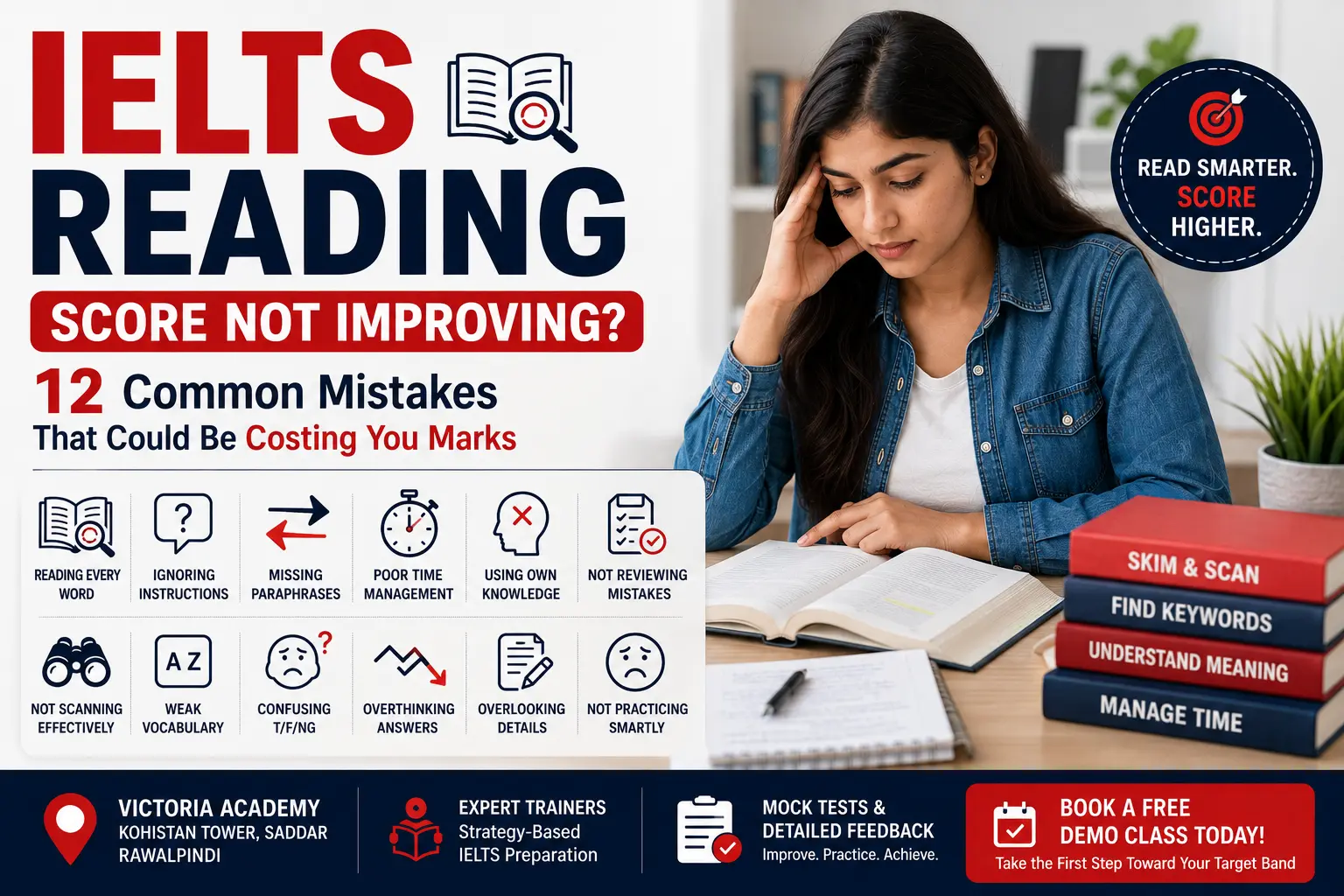
IELTS Reading can be frustrating because sometimes the problem isn’t understanding English.
You read the passage. You understand what it is about. Most of the vocabulary looks familiar.
Then you check your answers.
Wrong. Wrong. Correct. Wrong.
If this keeps happening, simply completing more Reading tests may not solve the problem.
Students preparing for IELTS Reading in Rawalpindi often focus on increasing their reading speed, but IELTS Reading performance also depends on understanding question instructions, recognizing paraphrasing, locating information efficiently, managing time, and avoiding small but expensive mistakes.
If your IELTS Reading score is not improving, here are 12 areas worth checking before you complete another stack of practice tests.
1. You Read the Passage Like a Newspaper Article
This is one of the most common IELTS Reading mistakes.
When reading something interesting online, you might start at the first sentence and carefully read everything until the end.
IELTS Reading has a different purpose.
You are reading to answer questions accurately within a limited amount of time.
That means you need different reading techniques depending on what you’re looking for.
You may need to:
- Skim for the general idea
- Scan for a name or number
- Read a particular paragraph carefully
- Locate keywords
- Recognize synonyms
- Compare a statement with the passage
Reading every sentence at exactly the same speed can waste valuable time.
2. You’re Looking for the Exact Words From the Question
IELTS frequently tests whether you understand meaning rather than whether you can match identical words.
Suppose a question refers to:
“A significant decrease in the number of passengers.”
The passage might say:
“Passenger numbers fell considerably.”
The wording is different.
The meaning is similar.
If you’re searching only for the exact word decrease, you may struggle to locate the information.
This is why paraphrasing and vocabulary are so important in IELTS Reading preparation.
3. You Don’t Read the Instructions Carefully
A correct answer can become incorrect simply because you ignored the instructions.
For example:
NO MORE THAN TWO WORDS AND/OR A NUMBER
If you write more than the permitted amount, your answer may not be accepted even if you understood the passage correctly.
Train yourself to check the instructions before starting each question set.
Pay particular attention to:
- Word limits
- Whether letters or words are required
- Whether an answer can be used more than once
- What information the question actually asks for
This takes only a few seconds.
Those seconds can save marks.
4. True, False and Not Given Are Still Confusing You
This question type causes enormous frustration.
The basic distinction is important.
TRUE: The statement agrees with the information in the passage.
FALSE: The passage contradicts the statement.
NOT GIVEN: The passage does not provide enough information to decide.
The biggest mistake is using your own knowledge.
Imagine the passage says:
“The university opened a new science building in 2020.”
The statement says:
“The new science building cost more than the university library.”
You may think that sounds possible.
But unless the passage provides information allowing that comparison, your outside knowledge or assumptions should not determine the answer.
IELTS Reading tests the text in front of you.
5. You’re Spending Too Long on One Difficult Question
You find a difficult question.
Two minutes pass.
Then three.
You reread the same paragraph.
You change your answer.
Then you change it back.
Meanwhile, the rest of the test is waiting.
One difficult question should not destroy your timing for an entire section.
If you cannot confidently locate the answer after a reasonable attempt, move forward and return later if time permits.
Protect your time.
6. You Practice Reading but Ignore Vocabulary
Reading strategies can only take you so far if unfamiliar vocabulary appears constantly.
The solution is not to memorize an entire dictionary.
Build vocabulary through regular exposure to English.
Read content related to subjects such as:
- Science
- Education
- Environment
- Technology
- Society
- Psychology
- History
- Business
When you encounter an unfamiliar word, don’t learn only its Urdu translation.
Learn:
- Its meaning in context
- Synonyms
- Common word forms
- Typical collocations
- An example sentence
This makes the vocabulary much easier to recognize later.
7. You Don’t Recognize Paraphrasing
Paraphrasing is everywhere in IELTS Reading.
Consider these pairs:
Children → Young people
Purchase → Buy
Decline → Reduction
Difficult → Challenging
Approximately → Roughly
But paraphrasing can also involve complete phrases.
For example:
“People are increasingly dependent on private vehicles.”
could relate to:
“Reliance on personal cars has grown.”
Students with strong paraphrasing recognition can often locate answers much faster.
8. You Panic When You Don’t Know One Word
You encounter an unfamiliar word and stop.
You read it again.
You try to remember whether you’ve seen it before.
You start guessing its meaning.
Thirty seconds disappear.
Often, you don’t need to know that word at all.
Use the surrounding sentence to determine whether the word is essential to answering the question.
Good readers can continue understanding a passage even when some vocabulary is unfamiliar.
That is an important skill both inside and outside IELTS.
9. You’re Not Using Paragraph Purpose
Instead of seeing a Reading passage as one giant wall of text, try to understand what each paragraph is doing.
For example:
Paragraph A: Introduces the problem
Paragraph B: Explains its history
Paragraph C: Presents research
Paragraph D: Discusses criticism
Paragraph E: Suggests possible solutions
Once you understand the structure, finding information becomes easier.
If a question asks about criticism of a theory, you already have an idea of where to look.
This is particularly useful for questions involving headings and matching information.
10. You Keep Practicing the Questions You’re Already Good At
Students naturally prefer tasks they can complete successfully.
If Matching Headings feels easy, you might happily practice it repeatedly.
If True/False/Not Given causes problems, you may avoid it.
That feels better.
But it doesn’t necessarily improve your score.
Analyze your previous Reading tests and identify the question types where you consistently lose marks.
Those questions deserve more attention.
Your weakest task may offer the biggest opportunity for improvement.
11. You Check the Score but Don’t Analyze the Mistakes
Imagine you complete a Reading test and score 27 correct answers.
You check the answer key.
Then you immediately begin another test.
You have learned very little from the first one.
For every incorrect answer, ask:
Why did I get this wrong?
Possible reasons include:
- Vocabulary problem
- Misread instruction
- Incorrect keyword
- Paraphrase not recognized
- Poor time management
- Assumption
- Careless spelling
- Question-type confusion
Once you identify patterns, your mistakes become useful information.
12. You Only Read IELTS Practice Passages
This sounds strange.
Surely IELTS preparation should involve IELTS passages?
Absolutely.
But if the only English you read is exam material, you may be limiting your broader language development.
Regular reading helps improve:
- Vocabulary
- Reading speed
- Concentration
- Grammar awareness
- Paraphrase recognition
- Understanding of unfamiliar topics
Try reading quality English content outside your IELTS study time.
The goal is to become a stronger reader—not simply someone who has completed many IELTS books.
How to Practice IELTS Reading More Effectively
Instead of completing a full test every day, divide your preparation.
One session might focus entirely on True/False/Not Given.
Another might focus on Matching Headings.
A third could concentrate on vocabulary and paraphrasing.
Then complete a timed Reading test to measure whether those individual skills have improved.
A useful cycle is:
Practice Skill → Complete Timed Questions → Analyze Mistakes → Correct Weakness → Retest
This gives your preparation a clear purpose.
Create an IELTS Reading Error Log
After every test, record the questions you got wrong.
Don’t simply write the correct answer.
Write the reason.
For example:
Question 8 – Wrong because I confused FALSE with NOT GIVEN.
Question 14 – Missed paraphrase: “rapid expansion” = “grew quickly.”
Question 21 – Spent too long searching one paragraph.
Question 30 – Answer exceeded word limit.
After several tests, patterns may become obvious.
Now you know exactly what to practice.
Improve Reading Speed Without Racing
Students often ask how to read faster.
The answer is not to force your eyes across the page as quickly as possible.
Reading efficiently means knowing when to read quickly and when to slow down.
You can skim introductory information rapidly.
You can scan for a date or proper noun.
But once you locate the paragraph containing the answer, you may need to read a few sentences very carefully.
Speed without comprehension is useless.
Efficiency is the real goal.
Should You Read the Questions or Passage First?
There is no single method that works perfectly for every candidate and every question type.
Some students prefer reviewing questions before searching the passage.
Others benefit from quickly understanding the passage structure first.
Your IELTS preparation should help you experiment with different approaches and determine which one produces the best balance of speed and accuracy.
Don’t follow a strategy simply because someone on social media calls it a “secret.”
Test it.
Measure the result.
Keep it only if it works for you.
Why Mock Tests Matter
Individual practice helps develop skills.
Full mock tests show whether you can use those skills under pressure.
A realistic IELTS Reading mock can reveal:
- Poor time allocation
- Loss of concentration
- Difficulty with later passages
- Question types that consume too much time
- Accuracy problems when you’re rushing
Your mock test should not simply produce a score.
It should tell you what to work on next.
When IELTS Reading Coaching Can Help
Self-study can work well when you understand why your answers are incorrect.
But some students reach a point where they repeatedly make the same mistakes without understanding the reason.
Structured IELTS coaching in Rawalpindi can help candidates identify patterns in their Reading performance and learn how different question types should be approached.
An instructor can also help determine whether the real problem is:
- Vocabulary
- Comprehension
- Timing
- Question interpretation
- Paraphrasing
- Exam technique
That makes preparation more targeted.
IELTS Reading Preparation at Victoria Academy Rawalpindi
Victoria Academy provides IELTS preparation in Rawalpindi covering Reading, Listening, Writing, and Speaking.
IELTS Reading preparation can help students become familiar with different question types while developing vocabulary, comprehension, time management, skimming, scanning, and paraphrase recognition.
Students can also use practice and mock tests to identify weaker areas rather than simply completing exercises without understanding their mistakes.
Victoria Academy is located at Kohistan Tower, Saddar, Rawalpindi, providing an accessible option for students looking for IELTS classes in Rawalpindi.
The academy offers a comfortable study environment with air-conditioned classrooms, interactive LED screens, high-speed internet, modern study resources, printer and scanner access, ergonomic seating, discussion areas, and additional tutoring support.
Online options are also available for students who prefer greater flexibility.
Experience a Free IELTS Demo Class
If you’re comparing different options for IELTS preparation in Rawalpindi, consider experiencing the teaching environment before enrolling.
A demo class allows you to evaluate:
- Teaching style
- Instructor communication
- Classroom environment
- Learning resources
- Course approach
Victoria Academy offers a free demo class for students interested in exploring its IELTS preparation program.
Frequently Asked Questions
Why is my IELTS Reading score not improving?
Common reasons include poor time management, limited vocabulary, difficulty recognizing paraphrases, misunderstanding question types, ignoring instructions, and failing to review mistakes after practice tests.
How can I improve IELTS Reading quickly?
Identify the question types where you lose the most marks, practice them individually, improve vocabulary and paraphrasing skills, and regularly complete timed exercises.
Should I read every word in IELTS Reading?
Not always. Different questions require different techniques. Skimming and scanning can help locate information, while careful reading is useful once you find the relevant section.
How can I improve True/False/Not Given questions?
Base your decision only on information provided in the passage. Do not use assumptions or outside knowledge, and clearly distinguish between contradictory information and information that is simply absent.
Where can I prepare for IELTS Reading in Rawalpindi?
Victoria Academy provides IELTS preparation in Rawalpindi, including Reading practice, mock tests, instructor guidance, and preparation across all four IELTS skills.
Final Thoughts
If your IELTS Reading score is stuck, completing more passages is not automatically the solution.
Your incorrect answers are telling you something.
Maybe you’re missing paraphrases.
Maybe you’re reading too slowly.
Maybe True/False/Not Given is costing you marks.
Maybe your vocabulary needs improvement.
Or perhaps you’re simply losing valuable time on difficult questions.
Find the pattern first.
Then fix it.
For students searching for IELTS Reading preparation in Rawalpindi, focused practice, detailed error analysis, and structured guidance can make preparation much more productive.
Don’t measure progress by how many Reading tests you’ve completed.
Measure it by how many of your recurring mistakes you’ve stopped making.