

You know the answer in your head.
The examiner asks a fairly simple question. You understand every word, but suddenly your mind starts searching for the “perfect” IELTS response. You pause, restart your sentence, try to remember an impressive phrase you learned online, and your normally comfortable English begins to sound unnatural.
This happens to many IELTS candidates.
One of the biggest misconceptions about IELTS Speaking preparation is that you need sophisticated answers filled with difficult vocabulary to achieve a strong band score. In reality, trying too hard to sound impressive can sometimes make speaking less natural.
If you’re preparing for IELTS Speaking in Rawalpindi, your goal should not be to memorize hundreds of answers. You need to become comfortable understanding questions, developing ideas, expressing yourself clearly, and maintaining a natural conversation.
Here is how to approach IELTS Speaking more effectively.
Why IELTS Speaking Feels Different From Normal Conversation
You may speak English comfortably with friends or colleagues but become nervous during an IELTS Speaking practice test.
Why?
Because normal conversations don’t usually make you think:
Was that grammar correct?
Was that vocabulary advanced enough?
Did I speak for long enough?
What band would that answer receive?
When candidates think about all these things while speaking, their natural fluency can disappear.
Effective IELTS Speaking preparation should gradually make the test format familiar enough that you can concentrate on communicating rather than constantly judging every sentence you produce.
Understand What IELTS Speaking Is Assessing
Your Speaking performance is assessed across key areas including:
- Fluency and coherence
- Lexical resource
- Grammatical range and accuracy
- Pronunciation
This means that speaking quickly or using complicated words alone will not produce a strong result.
You need a balance.
Your ideas should connect logically, your vocabulary should fit the topic, your grammar should allow you to express different ideas, and your pronunciation should make you easy to understand.
Stop Trying to Give a “Band 9 Answer”
Search online for an IELTS Speaking topic and you’ll find endless examples labelled:
Band 9 Answer
Students sometimes memorize these responses almost word for word.
Then the examiner changes the question slightly.
The memorized answer no longer fits.
The candidate tries to force it into the conversation anyway, and the response starts sounding rehearsed.
Instead of memorizing answers, develop the ability to talk about topics.
For example, if you’re practicing the topic of travel, think about:
- Places you have visited
- Places you want to visit
- Why people travel
- Tourism in your country
- Advantages of travelling
- Problems caused by tourism
- Travelling alone versus with others
Now you have flexible ideas that can be adapted to many different questions.
Simple English Can Still Be Strong English
Suppose the examiner asks:
“Do you enjoy spending time outdoors?”
You don’t need to respond with an unnecessarily complicated sentence.
A natural answer could be:
“Yes, especially in the evening. I spend quite a lot of time indoors because of work, so going for a walk helps me relax and clear my mind.”
The vocabulary isn’t extraordinary.
But the response is clear, relevant, developed, and natural.
That is far better than forcing several memorized expressions into an answer that doesn’t sound like you.
Don’t Give One-Word Answers
While you shouldn’t make every answer unnecessarily long, very short responses give you limited opportunity to demonstrate your English.
For example:
Examiner: Do you enjoy cooking?
Candidate: Yes.
Technically, the question has been answered.
But you haven’t demonstrated much language ability.
A more useful response might be:
“Yes, I do, although I wouldn’t say I’m an expert. I usually cook simple meals at home, especially on weekends when I have more time.”
The answer develops naturally without becoming excessive.
Learn the Answer + Reason + Example Habit
When you struggle to develop answers, use a simple mental pattern:
Answer → Reason → Example
For example:
Question: Do you prefer studying alone or with other people?
Answer: I generally prefer studying alone.
Reason: I can concentrate better when the environment is quiet.
Example: If I’m preparing for an exam, I usually study by myself and then discuss difficult topics with friends later.
You don’t have to follow this structure mechanically every time.
It simply trains you to move beyond one-sentence responses.
Fluency Does Not Mean Speaking Without Pausing
Natural speakers pause.
The problem is not every pause.
The problem is frequent hesitation that interrupts communication.
There is a difference between:
“I think… public transport… is… um… important because… um…”
and:
“I think public transport is important because it gives people an affordable alternative to driving.”
The second response flows more naturally.
Your goal should be to reduce unnecessary hesitation, not eliminate every pause from your speech.
Stop Translating Urdu Into English in Your Head
For many Pakistani IELTS candidates, this can be a major source of hesitation.
You think of the complete answer in Urdu.
Then you translate it.
Then you check whether the English sounds correct.
Then you finally speak.
That process is too slow for a natural conversation.
Try developing the habit of thinking directly in simple English.
Start with everyday activities.
While driving, studying, shopping, or walking, describe things mentally in English.
For example:
“Traffic is unusually heavy today.”
“I need to finish this work before lunch.”
“The weather feels much better this evening.”
These small habits help make English production more automatic.
Pronunciation Is About Clarity, Not Copying an Accent
You do not need to sound British.
You do not need to sound American.
And you certainly don’t need to spend your preparation trying to erase every sign of your natural accent.
The important question is:
Can the listener understand you clearly?
Work on:
- Clear word endings
- Correct syllable stress
- Understandable sounds
- Natural sentence rhythm
- Appropriate pace
Trying to imitate an unfamiliar accent can sometimes make your speech less natural.
Clarity should come first.
Record Yourself Speaking
Listening to your own voice can feel uncomfortable initially.
Do it anyway.
Choose an IELTS topic and record yourself answering for one or two minutes.
Then listen carefully.
Don’t just ask whether your English sounds “good.”
Look for specific issues:
- Did I repeat words?
- Did I pause excessively?
- Did I answer the question?
- Did I develop my ideas?
- Did I use the same vocabulary repeatedly?
- Were some words difficult to understand?
- Did I restart sentences?
- Did I use too many fillers?
This turns Speaking practice into something measurable.
Watch Out for Filler Words
Everyone uses fillers occasionally.
Problems appear when almost every sentence contains:
- Umm
- Actually
- Basically
- You know
- Like
- I mean
Some candidates even memorize fillers because they believe these make their English sound natural.
They don’t if used excessively.
Instead of inserting unnecessary expressions, allow yourself a brief natural pause when you need to think.
Learn Vocabulary by Topic, Not Alphabetically
Memorizing random vocabulary from A to Z is unlikely to transform your Speaking performance.
Learn words around common conversation topics.
For example:
Education
- Curriculum
- Qualification
- Academic pressure
- Practical skills
- Higher education
Environment
- Air pollution
- Renewable energy
- Waste management
- Public transport
- Environmental awareness
Technology
- Digital communication
- Automation
- Social media
- Online privacy
- Artificial intelligence
Most importantly, practice using these expressions in actual sentences.
Knowing a word and being able to use it naturally while speaking are two different skills.
Grammar Matters, but Don’t Edit Yourself Mid-Sentence
Imagine saying:
“My brother work—sorry, works—at a company that…”
Constantly correcting yourself can damage your fluency.
Of course, grammatical accuracy matters. But Speaking practice should help correct recurring grammar problems until the correct forms become more automatic.
If you make a minor mistake during a response, continuing naturally may sometimes be better than repeatedly restarting sentences.
After practice, review the mistake and work on it separately.
IELTS Speaking Part 1: Don’t Overcomplicate It
Part 1 generally involves familiar subjects related to you and everyday life.
The questions may concern topics such as:
- Home
- Studies
- Work
- Hobbies
- Transport
- Food
- Technology
- Daily routines
Respond naturally and develop your answers enough to demonstrate your English.
You don’t need to turn every question into a two-minute speech.
IELTS Speaking Part 2: Learn to Organize Ideas Quickly
The longer speaking turn can be intimidating because you need to speak continuously about a given topic.
Instead of trying to memorize a complete response, learn to organize ideas quickly.
When preparing, note a few keywords.
If the topic concerns a memorable journey, your notes might include:
Islamabad → family → weekend → mountains → weather → unexpected rain → memorable
Those words give you a route through the story without forcing you to memorize complete sentences.
This usually produces more natural speech.
IELTS Speaking Part 3: Go Beyond Personal Answers
Part 3 often requires broader discussion.
You may need to explain:
- Why something happens
- How society is changing
- Advantages and disadvantages
- Possible future developments
- Differences between groups or generations
A useful structure is:
Opinion → Explanation → Example
If appropriate, you can also acknowledge another perspective.
This helps you develop more substantial answers without memorizing them.
Practice Unfamiliar Questions
Many students repeatedly practice the topics they like.
That creates false confidence.
The real test may ask about something you have never considered.
Occasionally choose random topics and give yourself only a few seconds to respond.
You are training your ability to think in English, not simply recall prepared material.
Speak English Outside Your IELTS Class
Three Speaking exercises per week are not enough if you spend the rest of your time avoiding English conversation.
Create opportunities to speak.
You can:
- Discuss a news story in English
- Explain your day aloud
- Speak with classmates
- Record voice notes
- Describe something you see
- Summarize a video
- Give your opinion on a random topic
Ten minutes of genuine speaking every day can be extremely useful.
Why Mock Speaking Tests Matter
Knowing Speaking strategies and performing under test conditions are different experiences.
Mock Speaking tests help you become familiar with:
- Receiving unexpected questions
- Responding immediately
- Speaking for an extended period
- Maintaining eye contact
- Handling nervousness
- Moving between topics
They can also reveal weaknesses you don’t notice during casual practice.
Why Instructor Feedback Can Make a Difference
Speaking is difficult to assess by yourself.
You may not notice your own pronunciation habits or repeated grammar errors.
An experienced instructor can identify areas such as:
- Repetitive vocabulary
- Weak answer development
- Excessive hesitation
- Pronunciation issues
- Grammar patterns
- Memorized language
- Lack of coherence
This allows your practice to target specific problems instead of simply “speaking more.”
IELTS Speaking Preparation at Victoria Academy Rawalpindi
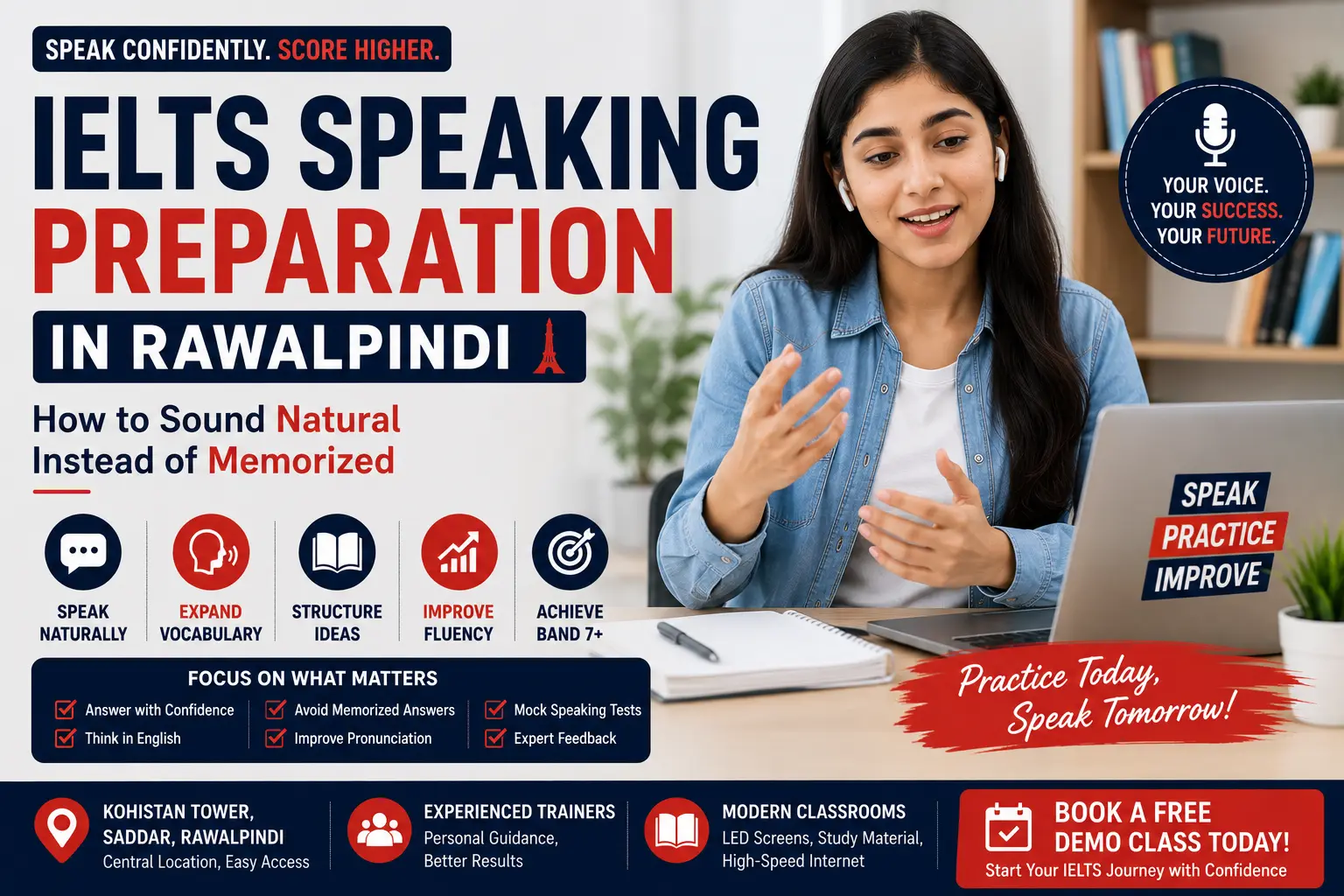
For students looking for IELTS Speaking preparation in Rawalpindi, Victoria Academy provides structured IELTS training across Speaking, Listening, Reading, and Writing.
Speaking preparation can help students develop confidence, improve fluency, expand useful vocabulary, work on pronunciation, and become more comfortable responding to unfamiliar questions.
Students can also benefit from instructor feedback and practice designed to identify individual weaknesses.
Victoria Academy is located at Kohistan Tower, Saddar, Rawalpindi, with a learning environment that includes comfortable air-conditioned classrooms, interactive LED screens, high-speed internet, study resources, discussion areas, and additional tutoring support.
Online learning options are also available for students who need greater flexibility.
Try a Free IELTS Demo Class
If you’re comparing options for IELTS classes in Rawalpindi, experiencing the teaching yourself can be more useful than simply reading advertisements.
Victoria Academy offers a free demo class, giving prospective students an opportunity to experience the learning environment and teaching approach before enrolling.
This allows you to decide whether the course suits your learning style and preparation needs.
Frequently Asked Questions
How can I improve IELTS Speaking fluency?
Speak English regularly, reduce unnecessary translation, record yourself, practice unfamiliar questions, and focus on communicating continuously rather than creating perfect sentences.
Should I memorize IELTS Speaking answers?
No. Develop vocabulary and ideas around common topics so you can create answers naturally when the question changes.
Do I need a British accent for IELTS?
No. Clear and understandable pronunciation is more important than imitating a particular accent.
How can I practice IELTS Speaking at home?
Record responses to IELTS-style questions, describe everyday situations aloud, summarize videos, discuss topics in English, and review your recordings for repeated weaknesses.
Where can I prepare for IELTS Speaking in Rawalpindi?
Victoria Academy provides IELTS preparation in Rawalpindi, including Speaking practice, instructor guidance, and preparation for Listening, Reading, and Writing.
Final Thoughts
Strong IELTS Speaking preparation should make you sound more like yourself in English—not more like a memorized model answer.
Develop your ideas.
Speak regularly.
Improve your vocabulary.
Work on recurring grammar and pronunciation problems.
Most importantly, become comfortable responding to questions you haven’t prepared in advance.
If you’re looking for an IELTS academy in Rawalpindi, choose preparation that gives you opportunities to actually speak, receive feedback, and build confidence under realistic conditions.
The examiner does not need to hear a rehearsed speech.
They need to hear your English.