

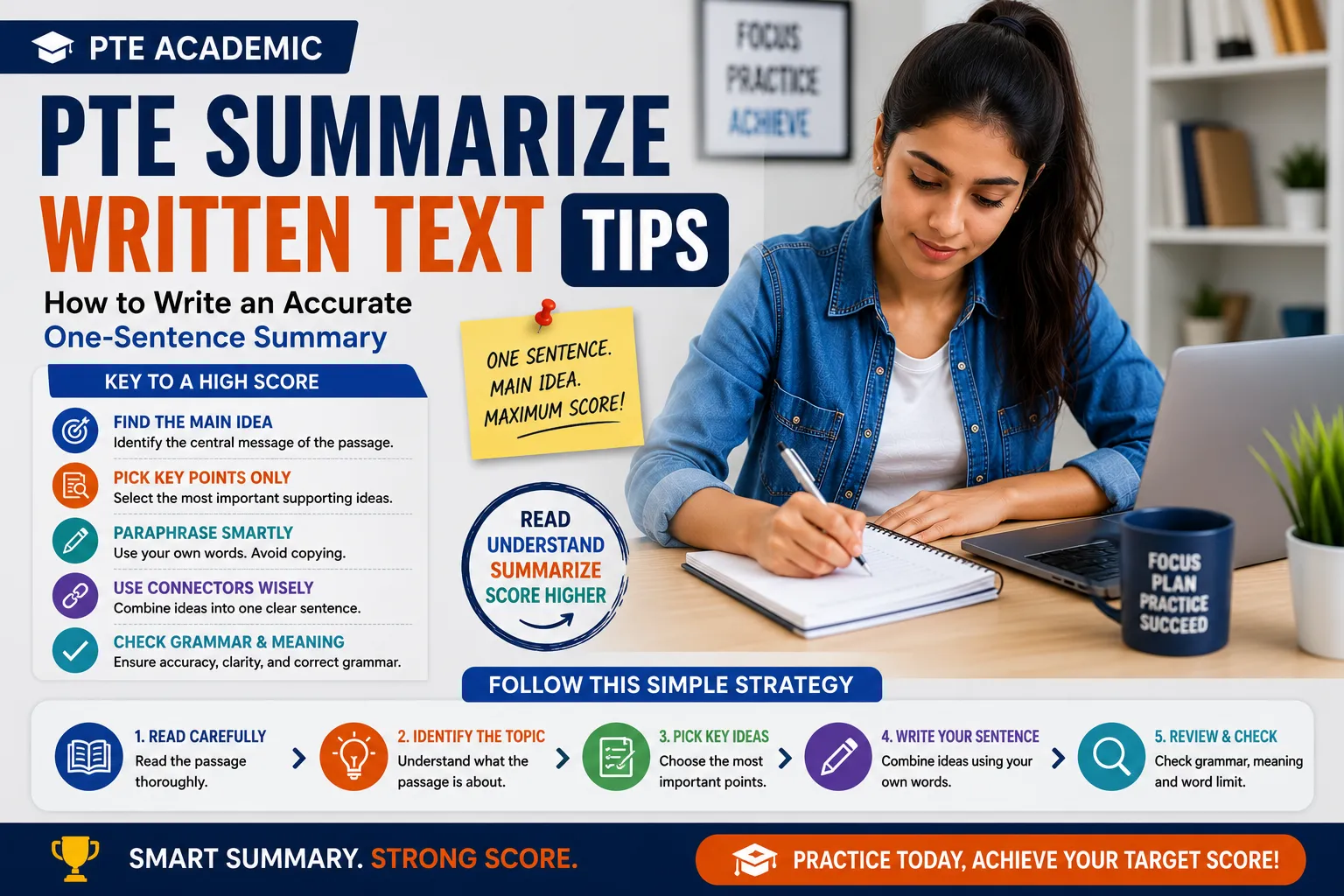
The PTE Summarize Written Text task can appear simple because candidates only need to write one sentence. However, producing one clear, grammatically correct sentence that captures the main idea of an entire passage can be surprisingly challenging.
Many students either include too many details, leave out the central argument, or create an extremely long sentence that becomes difficult to understand. Others focus so heavily on vocabulary that they forget the most important requirement: summarizing the passage accurately.
If you are searching for PTE Summarize Written Text tips, this detailed guide explains how the task works, what the scoring system evaluates, and how you can improve your response through practical reading and writing strategies.
Whether you are studying independently or attending a PTE academy in Rawalpindi, mastering this task can help strengthen both your Reading and Writing performance.
What Is PTE Summarize Written Text?
In the Summarize Written Text task, you receive an academic passage and must summarize it in a single sentence.
The passage may discuss topics such as:
- Education
- Science
- Technology
- Economics
- History
- Health
- Society
- The environment
Your response should present the passage’s main idea while including only the most important supporting information.
The purpose of this task is not to copy sentences from the passage. It is to show that you can read, understand, organize, and summarize information clearly.
Why This Task Is Important
Summarize Written Text tests several abilities at the same time.
It evaluates whether you can:
- Identify the central idea
- Separate major points from minor details
- Paraphrase information
- Build a complete sentence
- Use grammar and punctuation accurately
- Write clearly within a limited time
Because this task connects reading comprehension with writing ability, regular practice can benefit more than one part of your PTE Academic score.
How PTE Summarize Written Text Is Scored
Your response is evaluated according to several important areas.
Content
Your sentence should include the passage’s main message and the most relevant supporting ideas.
A grammatically perfect sentence may still receive a low score if it misses the central point.
Form
The response must follow the required format.
It should be written as one complete sentence and remain within the permitted word range shown in the test instructions.
Writing multiple sentences can affect your form score, even when the information is correct.
Grammar
Your sentence should be structurally complete and grammatically accurate.
The scoring system evaluates:
- Verb agreement
- Sentence structure
- Clause connection
- Punctuation
- Word forms
Vocabulary
You should use suitable vocabulary to express the passage’s meaning accurately.
Complicated vocabulary is not necessary. Clear and precise language is more effective.
Why Students Struggle with Summarize Written Text
Many candidates lose marks because they make one or more of the following mistakes:
- Copying too much from the passage
- Including examples instead of the main idea
- Writing more than one sentence
- Creating a sentence that is too long
- Using connectors incorrectly
- Changing the original meaning
- Ignoring grammar and punctuation
- Spending too much time on one passage
These problems usually come from a lack of structure rather than a lack of English knowledge.
Tip 1: Read for the Central Message
Before writing anything, ask:
What is the author mainly trying to explain?
Do not focus on every example, statistic, or explanation. Look for the overall message connecting the whole passage.
The central idea is often introduced near the beginning and developed throughout the text.
Tip 2: Identify the Main Supporting Points
After finding the main idea, identify two or three important supporting points.
These may include:
- Causes
- Effects
- Benefits
- Problems
- Comparisons
- Solutions
- Important developments
Minor examples and repeated explanations usually do not need to appear in your final summary.
Tip 3: Separate Main Ideas from Examples
A passage may contain several examples to explain one central argument.
For instance, a passage about renewable energy may mention solar, wind, and hydroelectric power. The examples support the broader idea of reducing dependence on fossil fuels.
Your summary should focus on the broader idea unless one example is essential to understanding the passage.
Tip 4: Paraphrase Instead of Copying
Paraphrasing means expressing the same idea using different words or sentence structures.
For example:
Original:
“Online education has increased access to learning for students living in remote areas.”
Paraphrased:
“Digital learning has made education more accessible to people in distant locations.”
You do not need to change every word. The goal is to show understanding while preserving the original meaning.
Tip 5: Use a Clear Sentence Structure
A reliable summary structure is:
Main idea + important supporting point + overall result or conclusion
For example:
“Although online learning provides greater flexibility and wider access to education, its effectiveness depends on reliable technology, student motivation, and appropriate academic support.”
This sentence presents the central topic, explains the key conditions, and remains easy to understand.
Tip 6: Use Connectors Carefully
Connectors help combine ideas into one sentence.
Useful options include:
- Although
- Because
- While
- Whereas
- Therefore
- However
- Since
- Which
- As a result
Do not use too many connectors in one sentence. A sentence containing several unrelated clauses may become confusing.
Tip 7: Keep the Sentence Manageable
Some students try to include every important detail and produce a sentence that is difficult to control.
A long sentence is not automatically a strong sentence.
Your response should be detailed enough to cover the main message but short enough to remain grammatically accurate and easy to follow.
Tip 8: Do Not Change the Author’s Meaning
When paraphrasing, be careful not to introduce your own opinion.
If the passage says a solution “may improve” a situation, do not write that it “will completely solve” the problem.
Your summary should remain faithful to the original text.
Tip 9: Check Grammar Before Submitting
After writing your sentence, review:
- Does it contain a subject and verb?
- Does the sentence make complete sense?
- Are the clauses connected correctly?
- Is the punctuation accurate?
- Have you used one sentence only?
A quick grammar check can prevent avoidable mistakes.
Tip 10: Practice Under Time Limits
Reading and summarizing without a timer may feel easy. The real challenge is completing the task accurately within the exam time.
During practice:
- Set a timer
- Read only once or twice
- Identify the main idea quickly
- Write the summary
- Review the sentence
Timed practice improves both speed and confidence.
A Step-by-Step Method for Summarize Written Text
Use this simple method during preparation and in the exam.
Step 1: Read the Entire Passage
Read for general understanding without stopping at every unfamiliar word.
Step 2: Identify the Topic
Ask what subject the passage discusses.
Step 3: Find the Main Argument
Determine what the writer says about that topic.
Step 4: Select Key Supporting Ideas
Choose only the most important causes, effects, arguments, or findings.
Step 5: Draft One Sentence
Combine the main idea and supporting points logically.
Step 6: Review the Response
Check form, grammar, meaning, punctuation, and word count.
Example of PTE Summarize Written Text
Imagine a passage explaining that urban green spaces reduce air pollution, support mental health, provide recreational areas, and make cities more comfortable.
A suitable summary could be:
“Urban green spaces improve city life by reducing pollution, supporting physical and mental wellbeing, and providing accessible areas for recreation and community interaction.”
The sentence does not repeat every detail, but it communicates the main argument and essential supporting points clearly.
Common Mistakes to Avoid
Writing Two Sentences
The task requires one sentence.
Use suitable connectors or relative clauses instead of adding a full stop between ideas.
Copying the Passage Word for Word
Some keywords may remain the same, but your sentence should demonstrate understanding rather than simple copying.
Adding Personal Opinions
Do not include phrases such as:
- I think
- In my opinion
- I believe
You are summarizing the writer’s ideas, not responding to them.
Including Unnecessary Statistics
Specific figures are rarely needed unless they are central to the passage’s argument.
Ignoring Punctuation
A very long sentence without commas or proper clause structure can become grammatically incorrect.
How to Improve Your Paraphrasing Skills
Paraphrasing becomes easier when you regularly practice:
- Replacing words with suitable synonyms
- Changing active sentences into passive structures
- Combining short sentences
- Changing the order of information
- Using noun and verb forms accurately
For example:
“Researchers discovered that exercise reduces stress.”
Can become:
“Research indicates that regular physical activity can lower stress levels.”
The meaning remains similar, but the sentence structure changes.
Daily Practice Routine
Monday
Read one short academic passage and identify its main idea.
Tuesday
Practice paraphrasing five sentences without changing their meaning.
Wednesday
Complete three Summarize Written Text exercises.
Thursday
Review connectors and complex sentence structures.
Friday
Complete timed practice questions.
Saturday
Review your previous responses and correct grammar mistakes.
Sunday
Take a full PTE Writing practice test.
Frequently Asked Questions
Should I include every idea from the passage?
No. Include the central idea and only the most important supporting points.
Can I copy keywords from the text?
Yes, when necessary. However, your response should not simply copy complete sentences from the passage.
Is a longer summary better?
Not necessarily. Accuracy, clarity, grammar, and relevance matter more than unnecessary length.
Do spelling mistakes affect the score?
Yes. Always review commonly misspelled words and check your response before submission.
How can I improve quickly?
Practice identifying the main idea of articles, news reports, and academic paragraphs. Then summarize each one in a single sentence.
Why Professional Feedback Helps
Students often believe their summaries are accurate because the grammar appears correct. However, they may have missed the passage’s main argument or included unnecessary details.
A qualified instructor can help identify:
- Incomplete summaries
- Incorrect paraphrasing
- Weak sentence construction
- Grammar problems
- Irrelevant information
- Poor use of connectors
Students preparing through a professional PTE academy in Rawalpindi can benefit from regular writing evaluation and targeted correction.
Final Thoughts
The PTE Summarize Written Text task becomes much easier when you stop trying to include everything and start focusing on the passage’s central message. A successful response presents the main idea, adds the most relevant supporting information, and communicates everything through one accurate and well-organized sentence.
Improve your performance by reading academic content regularly, strengthening paraphrasing skills, reviewing grammar, and practicing under timed conditions. Each summary you write will help you recognize important ideas faster and express them more clearly.
Whether you are studying independently or receiving guidance from a PTE academy in Rawalpindi, consistent practice and detailed feedback can help you improve your PTE Writing and Reading performance and move closer to your target score.